Rapid and efficient changes of medicines


Amgros works closely with the regions - hospital pharmacies, pharmaceutical committees and clinical pharmacologists - to ensure that new medicines get into use rapidly as standard treatment at hospitals - and thereby get to patients quickly too. Together, we also ensure that the regions can reap the savings as soon as possible because the medicine will have been through our national tendering procedure.

DENMARK HAS A SPECIALLY STRUCTURED SET-UP

It is a complex matter. Both when we are making sure that new medicines get out to patients at public hospitals; and when medicines at hospital pharmacies and on hospital shelves are to be replaced because other medicines have beaten the competition in a national tendering procedure.

Therefore, in Denmark we have established a specially structured set-up with collaboration between hospital pharmacies, pharmaceutical committees, clinical pharmacologists, economists and Amgros. We call it the Implementation Group.

Our role at Amgros is to contribute knowledge, advice and cooperation.  Amgros also performs the specialist secretariat function.
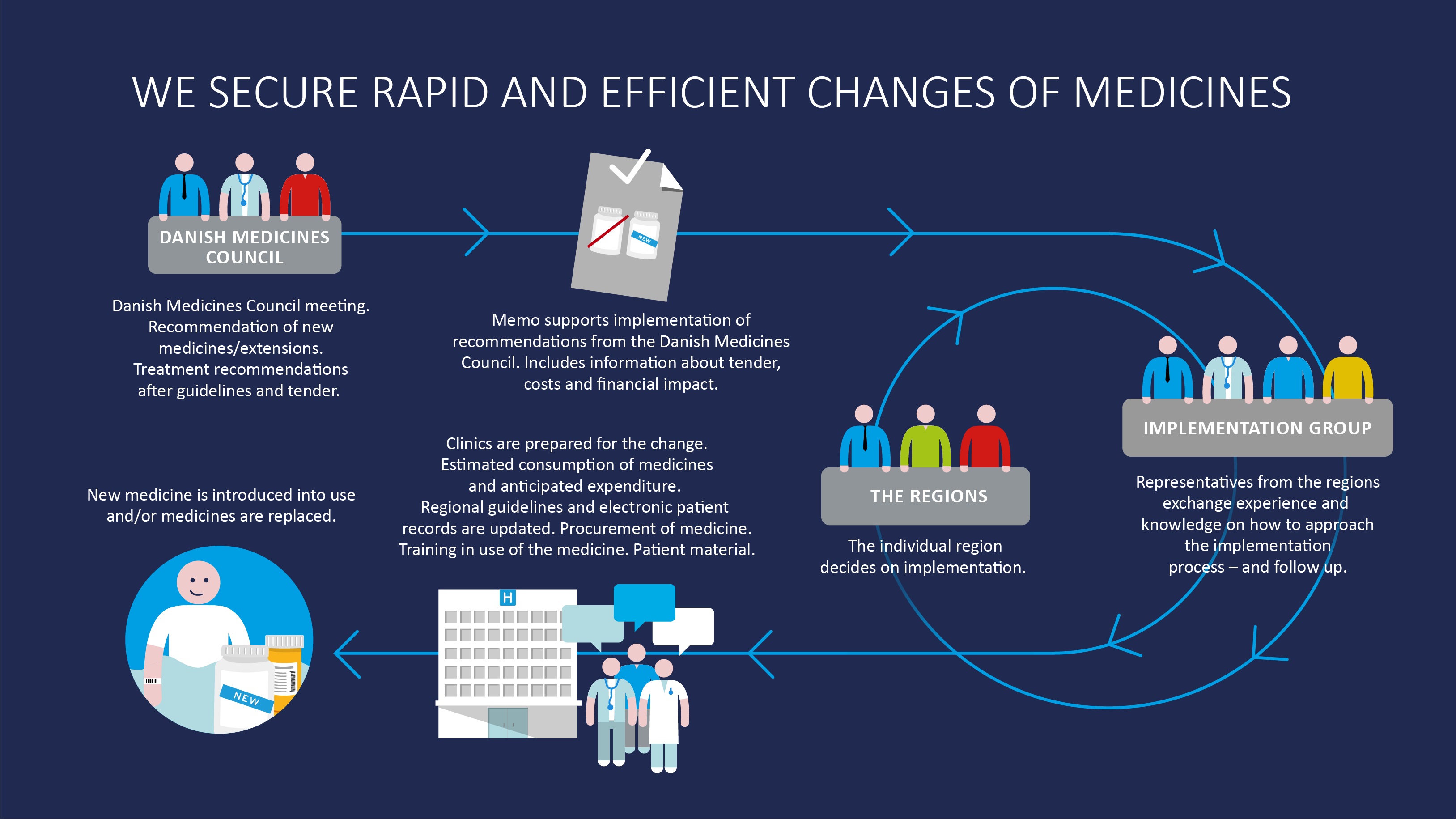
Process flow diagram called

RECOMMENDATION AND AUTHORISATION BY THE DANISH MEDICINES COUNCIL
Before a completely new medicine can be introduced as a standard treatment at public hospitals, the Danish Medicines Council must first evaluate and recommend it. This also applies when a medicine with an extended indication is to be recommended as standard treatment.

When multiple medicines are available to treat a disease, Amgros can conduct a tendering procedure in which the different medicines compete against each other in a national tender. The purpose is to create competition and achieve lower prices.

For Amgros to be able to conduct a tender, the Danish Medicines Council must prepare treatment guidelines, a clinical comparative basis, and, where relevant, a cost analysis for a therapeutic area, such as multiple sclerosis. The treatment guidelines and the clinical comparative basis describe which medicines are clinically equivalent and at which doses—that is, equally effective in treating patients within the relevant therapeutic area. This applies both to the efficacy of the medicines and to any potential side effects. The cost analysis describes the treatment-related costs associated with the medicines included in the clinical comparative basis.

Once Amgros has identified the winners of the tender, the Danish Medicines Council prepares a medicine recommendation. In this recommendation, the Council ranks the clinically equivalent medicines according to which are associated with the lowest costs. In this way, hospitals can see which medicines they should choose based on the overall costs.
AMGROS PREPARES AN IMPLEMENTATION MEMO
In order to support the regions in implementing the Danish Medicines Council’s medicine recommendations and its recommendations for new medicines and indications, Amgros prepares what we call an implementation memo. In the memo, we provide information on the financial implications of introducing a new medicine or complying with a medicine recommendation. In addition, we outline various market conditions and plans for tendering procedures.

In this way, we ensure both that the regions can incorporate the related medicine costs into their budgets and that they are prepared for developments within a given therapeutic area.
MEETING OF THE IMPLEMENTATION GROUP
After we have prepared and issued the implementation memo, the Implementation Group meets. The group consists of representatives from the regions – hospital pharmacies, pharmaceutical committees, and clinical pharmacologists – as well as Amgros.

All members of the group have a direct role in practical implementation. The group discusses how implementation can be carried out in practice and the practical considerations associated with the process. For example, if it concerns a new medicine that resembles one already used by hospitals, the regions discuss how they intend to proceed. They also consider how quickly they expect to switch medicines and how they plan to do so, what resources such a change will require, whether the new medicine requires more space or different handling, and whether patients may need to visit the hospital more frequently.
THE REGIONS DECIDE

The individual regions will then each decide how they will implement the change of medicine. This is usually in a process in which the Implementation Group continuously compares consumption across the regions to learn and consult with each other, and to help establish a consensus across the regions.
CLINICS ARE PREPARED FOR THE CHANGE
When hospitals need to switch medicines, they must update their clinical guidelines. If a guideline—for example on rheumatoid arthritis—states that a specific medicine should be used in a particular situation, but another medicine is now to be used, the region will need to revise its guideline.

The same applies to information in the electronic patient record, which must also be updated to include the new medicine. In addition, the medicine must be replaced physically—both at the hospital pharmacy and in the medicine room, and possibly with the patient. Furthermore, staff may need to be trained in handling the new medicine, and patients may require instruction in its practical use.

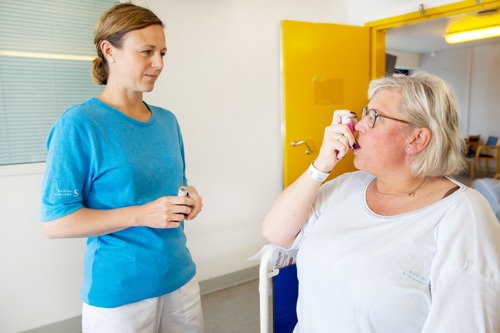
Patient bruger sin inhalator


We get new medicines into use very quickly

It only takes between one and 14 days from when the Danish Medicines Council recommends a new medicine to when the regions can order it and start using it to treat patients.

This is the result of a new analysis from the Implementation Group under the Interregional Forum for the Coordination of Medicine A structured national set-up makes this rapid process possible

Click here to read the article

The Implementation Group facilitates constructive and good collaboration between Amgros, pharmacists, pharmacologists and health economists in the regions.
Mette Marie H. Christensen ,
PhD, lead consultant, and clinical associate professor, OUH
When we in the regions share knowledge and experience about how we will implement guidelines and recommendations from the Danish Medicines Council, we create possibilities for consensus across Denmark.
Stine Trolle,
Pharmacist, unit for implementation and rational use of medicines, Capital Region of Denmark Pharmacy
The Implementation Group helps create an essential overview of where we each can do something actively to get a change of medicine implemented safely, rapidly and efficiently.
Anita Duedahl,
Hospital pharmacist, Lillebælt Hospital Pharmacy

READ MORE

Rapid and efficient changes of medicines

Pharmaceuticals

Danes are living longer. And we can treat more diseases, because new and better drugs are entering the market all the time. This is good. But it’s expensive. Therefore, it is important that we are at the forefront of market developments.

READ MORE
Rapid and efficient changes of medicines

Price negotiations and tendering

Amgros is responsible for the procurement of the majority of medicines used in public Danish hospitals. In addition, we negotiate prices for selected medicines for the primary healthcare sector.

READ MORE
Rapid and efficient changes of medicines

Analogue competition

When the Danish Medicines Council is to assess several pharmaceuticals within the same therapeutic area, it prepares treatment guidelines.

READ MORE
Rapid and efficient changes of medicines

Generic pharmaceuticals

When the patent on a pharmaceutical expires, and generic or biosimilar alternatives enter the market, Amgros’ task is to ensure the widest possible competition.

READ MORE

Jette Østergaard Rathe

Senior Medical Advisor

I work on developing a sustainable organizational setup for ATMP Denmark, translating this into concrete solutions for clinicians, researchers, and companies that create value for patients.

Mikala Vasehus Holck

Senior Medical Advisor

I work on improving and facilitating work to implement changes in medicines in the regions so they generate value for our cooperation partners.