
There is considerable interest in alternative agreements. At the same time, the number of specific proposals remains limited. Amgros therefore works closely with the Danish Medicines Council and suppliers to develop this area and create better opportunities for relevant agreements that can support access to new and innovative medicines.
Data and knowledge are central to this work and form the basis for dialogue and decision-making.
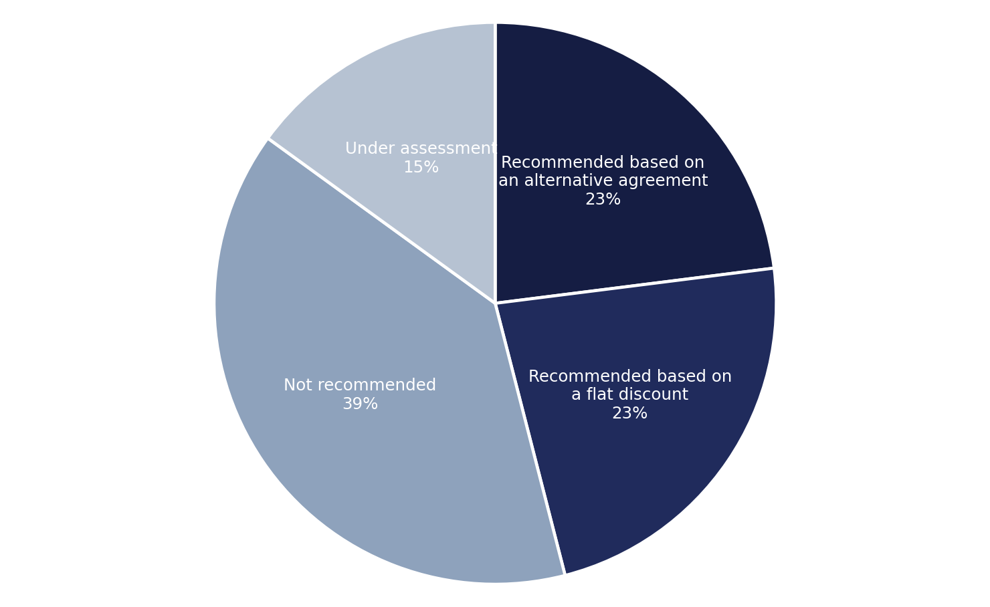
From 2021 to the end of September 2026, Amgros received 53 requests for alternative agreements. In 46% of the cases, the medicine was recommended by the Danish Medicines Council, either on the basis of the alternative agreement or on the basis of a flat discount.
When a supplier submits a request to Amgros and the Danish Medicines Council for an alternative agreement, the supplier must also offer an agreement based on a flat discount[LS2.1][KT2.2][LS2.3], allowing the Danish Medicines Council to compare the two models. When a medicine is recommended but no alternative agreement is concluded, this is often because the Danish Medicines Council has assessed that an agreement based on a flat discount is the better overall solution.
The chart below provides a historical overview of requests received since 2021 and the number of alternative agreements concluded.
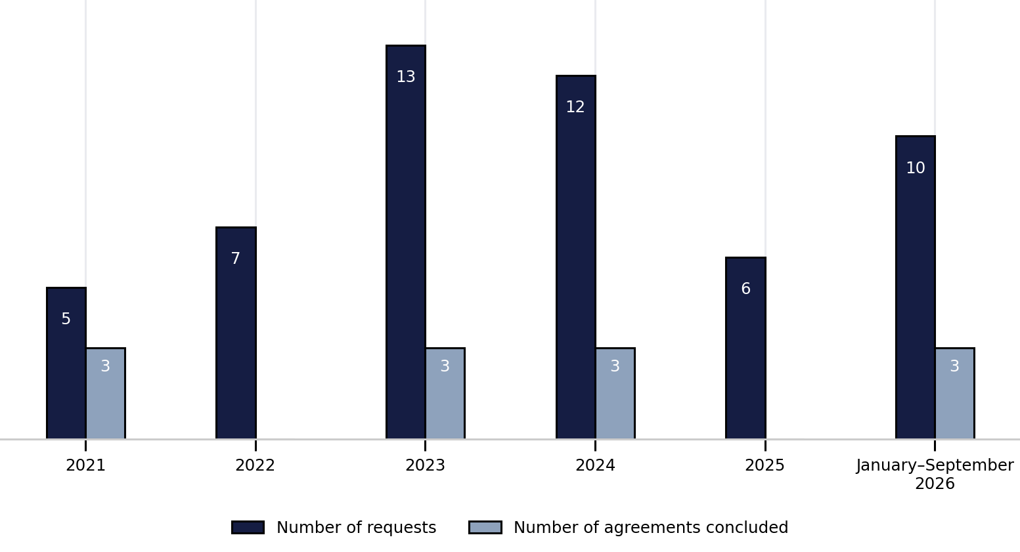
Our experience shows that concluding alternative agreements is not a quick fix.
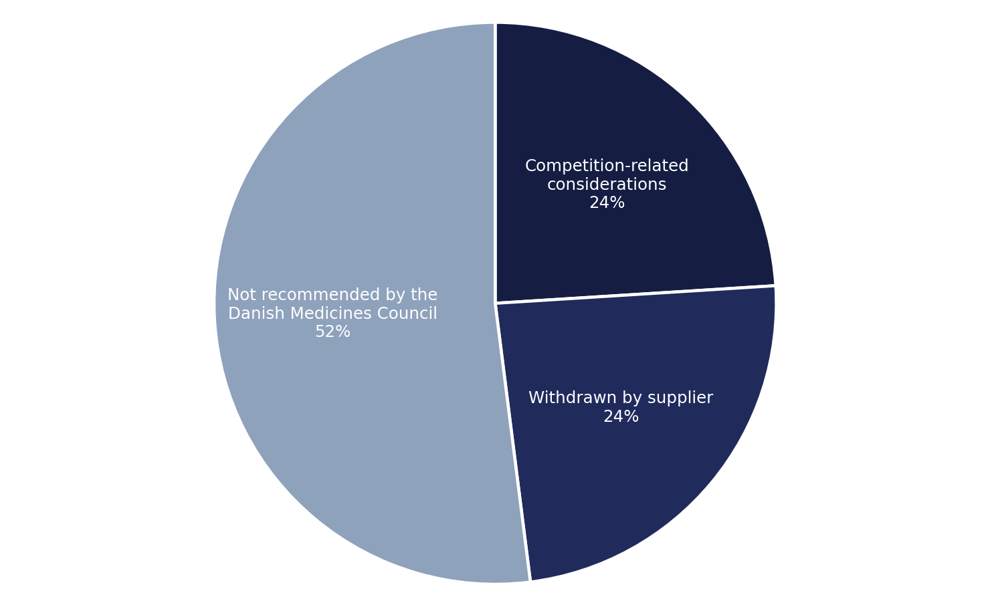
When a medicine is not recommended, there may be various reasons why an alternative agreement does not form part of the final decision.
In 24% of cases, the supplier withdrew its proposal for an alternative agreement during the process.
In a further 24% of cases, the alternative agreement did not form part of the decision because Amgros assessed that the proposed agreement could not be implemented. This may, for example, be due to competition considerations, Danish clinical practice, the processing of personal data, or the complexity and resources required for implementation.
In the remaining cases, the Danish Medicines Council concluded that, for various reasons, the medicine could not be recommended as standard treatment in Denmark.
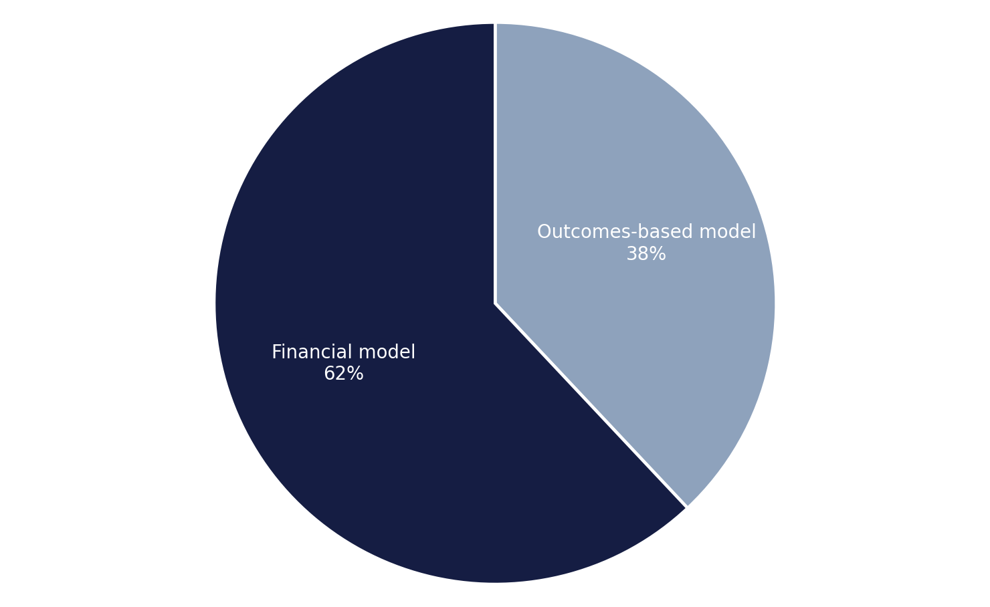
Amgros receives requests for many different types of alternative agreement models. The vast majority are proposals for financial models, which account for almost two thirds of the requests received by Amgros. These include price-volume models, budget-cap models and patient-initiation models.
The remaining requests concern outcomes-based models, including payment by results and conditional recommendation.
Requests for alternative agreements cover several disease areas. Approximately half concern solid tumors[KT3.1][LS3.2] or hematological cancers, while around 10% concern neuromuscular diseases. The remainder are spread across a range of other disease areas, including blood disorders, endocrinology, gastroenterology, infectious diseases, immunodeficiencies and transplantation, liver diseases, neurological diseases and rare hereditary diseases.
Read more about the different alternative agreement models here.

READ MORE
Price negotiations and tendering
Amgros is responsible for the procurement of the majority of medicines used in public Danish hospitals. In addition, we negotiate prices for selected medicines for the primary healthcare sector.
READ MORENew pharmaceuticals and negotiations
If a new medicine is to be considered as a standard treatment at Danish public hospitals, the Danish Medicines Council has to assess and recommend it first.
READ MORE
Alternative agreements
Amgros has been using alternative agreement models for several years. These ensure that patients have access to new, expensive and innovative medicines. We apply a number of principles for using alternative agreement models. Among other things, these principles ensure that all suppliers are treated equally.
READ MORE